What "substantial improvement" means and why it can trigger a full flood upgrade
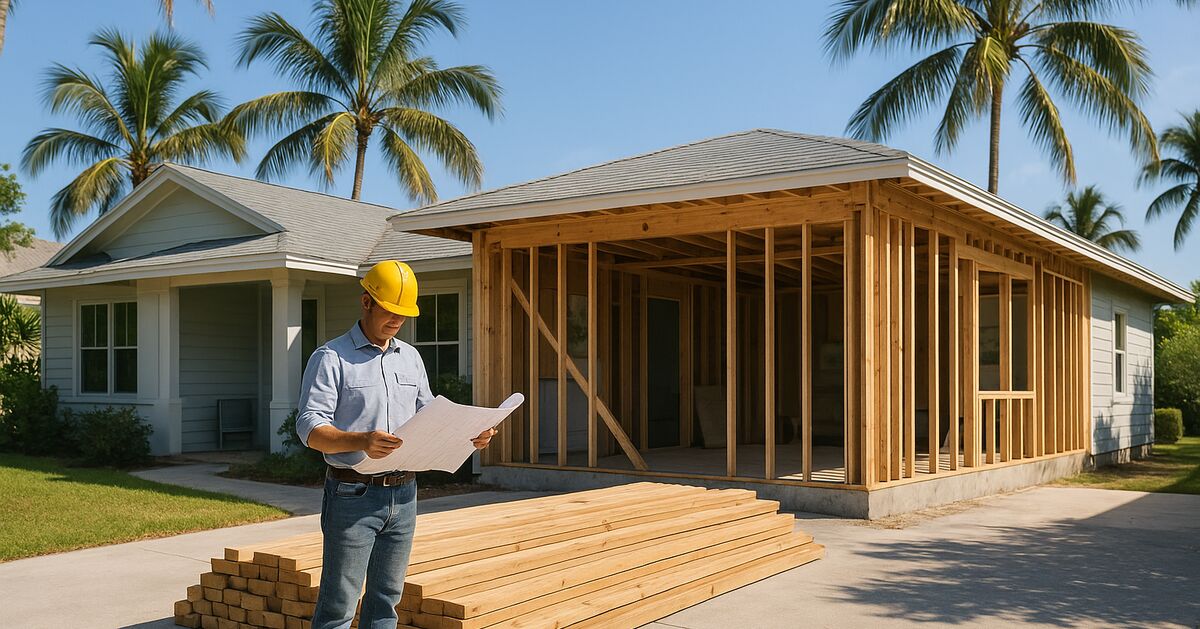
Your contractor hands you a renovation estimate and the number looks fine, right up until the county tells you that the project will cost more than half your home's market value and now you must raise the entire structure to current flood elevation. That moment surprises a lot of Sarasota homeowners, and it doesn't have to.
The rule behind that surprise is called "substantial improvement," and understanding it before you finalize a budget is one of the most valuable things you can do before pulling a permit in a flood zone. This post walks through what the rule actually says, how Sarasota County applies it, which costs count toward the threshold, and what your realistic options are when you're getting close to the line.
The legal definition, in plain language
The National Flood Insurance Program (NFIP), administered by FEMA, requires every participating community to enforce a substantial improvement rule as a condition of offering flood insurance to residents. Sarasota County participates in the NFIP and has adopted the rule into its local floodplain ordinance.
FEMA's definition: a substantial improvement is any reconstruction, rehabilitation, addition, or other improvement of a structure where the cost of the improvement equals or exceeds 50 percent of the market value of the structure before the improvement begins.
Two things in that sentence deserve emphasis. First, it says "market value of the structure," not the market value of the property. The land is excluded. Second, it says "before the improvement begins," so the baseline is set at the start of your project, not after construction drives up the assessed value.
When a project crosses that 50 percent threshold, the county is required to treat the building as if it were new construction. That means the entire structure must be brought into compliance with current flood zone requirements, including elevating the lowest floor to or above the Base Flood Elevation (BFE) for its zone, plus any local freeboard requirement Sarasota County has adopted on top of the FEMA minimum.
If you're already deep into flood zone permit territory, you may also want to read our earlier post on how FEMA elevation rules change what Sarasota County demands on Siesta Key, which covers the elevation side of the equation in detail.
Why this rule exists
The NFIP's goal is straightforward: over time, reduce the number of older buildings that sit below safe flood elevation. When a building undergoes major reconstruction anyway, FEMA and local governments use that moment to require a flood upgrade. The logic is that if you're already spending half the building's value, the cost of elevating it is proportionally less disruptive than it would be for an untouched structure.
That reasoning is sound in the abstract. In practice, it can feel brutal to a homeowner who planned a kitchen gut-renovation and suddenly faces a foundation lift. Understanding the rule in advance is the only way to avoid that outcome.
How Sarasota County determines market value
The "market value of the structure" is not the same as your Sarasota County Property Appraiser assessed value, your homestead value, your insurance replacement cost, or your Zillow estimate. Each of those numbers can differ significantly from one another, and none of them is automatically the number the county uses.
Sarasota County's floodplain administrator typically accepts one or more of the following as evidence of market value:
- A qualified independent appraisal of the structure (land excluded)
- The county's own assessed value adjusted by a state-published equalization factor
- Documented comparable sales data
If you have a formal appraisal that separates building value from land value, that is generally the strongest document to bring to the county. Property in neighborhoods like Palmer Ranch or The Meadows often has significant land value that, once stripped out, reduces the structural value considerably and gives you more headroom before hitting the 50 percent threshold.
In coastal communities like Siesta Key, where lot values can rival or exceed structure values, the land exclusion can work dramatically in your favor. A home with a $600,000 total market value might have only $250,000 attributable to the structure, meaning you could spend up to $124,999 before triggering the rule.
What costs count toward the threshold
This is where owners and even some contractors make costly assumptions. The county looks at the cost of the improvement, which FEMA guidance defines broadly.
Costs that generally count:
- All construction and labor costs
- Materials
- Contractor profit and overhead
- Architectural and engineering fees directly related to the project
- Site work directly associated with the improvement
Costs that generally do not count (with important caveats):
- Plans, surveys, permit fees, and similar soft costs not directly tied to construction (practice varies; confirm with the county)
- The value of volunteer labor
- Costs of repairing damage caused by a disaster (this is handled separately under "substantial damage" rules, which use the same 50 percent threshold but measure damage against pre-damage value)
One subtlety that trips up owners: Sarasota County, like most NFIP communities, uses a cumulative approach over a rolling period. If you renovated last year and want to renovate again this year, the county may add the two project costs together to see whether the combined total crosses the threshold. The specific look-back period is defined in the local ordinance; confirm the current policy with the Sarasota County Floodplain Management office before you scope your next project.
Our permit expediting services team regularly helps owners pull together cost documentation in a format the county will accept, which can avoid back-and-forth delays during plan review.
Neighborhoods most affected in the Sarasota area
The substantial improvement rule only matters if the building is located in a Special Flood Hazard Area (SFHA), the zones designated on FEMA's Flood Insurance Rate Maps (FIRMs) where the rule is enforced. In the Sarasota area, that covers a large footprint.
Siesta Key is almost entirely within SFHA zones. Many renovation projects on the key will be subject to floodplain review, and the BFE for many parcels sits well above existing first-floor elevations in older homes.
Osprey and Nokomis along U.S. 41 and near Little Sarasota Bay have significant AE and VE zone coverage. Older ranch-style homes in these areas were often built before the current FIRM was adopted and can be well below BFE.
Gulf Gate has pockets of flood zone property near the canal and drainage systems, though many interior lots are outside the SFHA. Owners there should verify their specific zone before assuming they are clear.
Fruitville and Bee Ridge are generally less affected because they are farther inland, but low-lying parcels near drainage corridors can still fall within mapped flood zones. Never assume based on neighborhood alone.
Palmer Ranch was largely developed after modern flood mapping and grading requirements were in place, so many structures sit at or above BFE already. That doesn't mean substantial improvement doesn't apply, but it may mean the required upgrade is less drastic if the floor elevation is already adequate.
You can find zone-specific information for each community we serve on our locations page.
What a full flood upgrade actually involves
If your project triggers the substantial improvement rule and your structure is below the required BFE, "compliance" is not a simple paperwork exercise. It involves real construction work, which can include:
- Elevating the structure on fill, piers, columns, or extended foundation walls so the lowest floor (including basement, if any) is at or above BFE plus freeboard
- Flood-proofing for non-residential buildings (an alternative to elevation in some zones, but rarely available for single-family homes)
- Enclosure requirements for space below the BFE, which must be used only for parking, access, or storage, with proper flood vents or breakaway walls
The cost of a full elevation project varies enormously depending on foundation type, soil conditions, utilities that must be relocated, and how far below BFE the existing floor sits. The point here is not to quote a price but to flag that these costs can be substantial and must be factored into your renovation planning before you commit.
The substantial damage parallel
Substantial improvement applies when you choose to renovate. Substantial damage applies when a storm, flood, or fire damages your home. The math is the same: if the cost to restore the structure to its pre-damage condition equals or exceeds 50 percent of the pre-damage market value of the structure, the county treats it as a new building and requires full flood compliance before you can rebuild.
This is the rule that affects homeowners after hurricane events. If your home in Osprey or Nokomis takes on significant flood damage and the county's substantial damage determination comes in at or above 50 percent, you cannot simply repair it in place. You must elevate. Understanding this distinction is important for insurance and for planning, because a voluntary improvement project and a disaster recovery project are both subject to the same threshold.
Planning your renovation budget with the rule in mind
Knowing the rule gives you real options, none of which involve ignoring it.
Option 1: Phase the work so no single permit period triggers the threshold. This approach requires careful documentation and an honest conversation with the county's floodplain administrator. Some owners do break projects into phases across different years. However, you must understand the cumulative look-back policy currently in effect and be transparent with the county. Phasing that looks like deliberate threshold avoidance can draw additional scrutiny.
Option 2: Get a credible appraisal early. If the land value on your parcel is high (as it often is on Siesta Key or near the bay in Nokomis), a qualified appraisal separating structure from land may show your structural value is lower than you expected, giving you a higher dollar threshold before the rule kicks in.
Option 3: Scope the project with the threshold in mind from the start. If you know your structure's market value is $300,000, you know $149,999 is your ceiling. Design the renovation to fit within that number and document costs carefully.
Option 4: Embrace the upgrade and plan financially for it. For some owners in older homes well below BFE, elevating during a renovation may help lower long-term flood insurance premiums, though the actual savings depend on individual policy factors and should be confirmed with an insurance agent. FEMA's Risk Rating 2.0 methodology considers flood risk factors in setting premiums, and elevating a home above BFE may help reduce premiums, though savings vary by property and should be checked with an insurer.
Our team can help you think through the sequencing and documentation of any of these approaches. See how we work with homeowners across Sarasota County for more on what that looks like in practice.
What to bring to the county before you start
Before any contractor breaks ground on a project in a flood zone, the county's floodplain management office will want to see:
- A completed permit application identifying the scope of work
- Cost documentation for all work (contractor bids, itemized estimates)
- Evidence of the structure's market value (appraisal or county records)
- An elevation certificate for the existing structure, if one exists
The elevation certificate is a licensed surveyor's document showing the current elevation of the lowest floor relative to BFE. If your property doesn't have a current one, you'll need to order one. It's a reasonable upfront cost that can prevent much larger surprises during plan review.
If you're not sure where your project stands on any of these requirements, the FAQ page covers many common questions, or you can reach out to us directly and we'll help you map out the process before you commit to a budget.
A word about unpermitted work in flood zones
One pattern that causes serious problems at resale: owners who renovated without permits in flood zones, either unaware of the rule or hoping to avoid it. When that work comes to light during a title search or county inspection, the county may require retroactive substantial improvement analysis based on the cost of the unpermitted work. If that analysis triggers the threshold, the owner faces a compliance order that must be resolved before the property can be sold or refinanced.
This scenario connects closely to what we've written about in unpermitted work found by Sarasota County and the mechanics of how code enforcement liens attach to a property. If you're buying a home in a flood zone and the permit history looks thin relative to the apparent condition of the house, that gap is worth investigating carefully. Our post on how to read a Sarasota County permit history report walks through exactly how to do that.
The bottom line
The substantial improvement rule is not a technicality you can work around by picking the right contractor or filing paperwork creatively. It is a federal program requirement that Sarasota County is obligated to enforce, and the county takes that obligation seriously. The good news is that the rule is entirely predictable once you understand it. Know your structure's market value, know your project's total cost, confirm the cumulative look-back period, and make your decisions with full information.
If you're planning a renovation in Sarasota, Siesta Key, Palmer Ranch, Gulf Gate, Osprey, Nokomis, or anywhere else in the county and you're not certain where you stand on the substantial improvement threshold, that is exactly the kind of question our permit expediting team is here to help you answer before it becomes an expensive surprise.
Sources & further reading
- Florida Building Code - Existing Building, Flood Provisions (Florida Building Commission)
- Federal Emergency Management Agency (named in this article) (Federal Emergency Management Agency)
Claim-by-claim audit (11 checked)
- “FEMA's definition: a substantial improvement is any reconstruction, rehabilitation, addition, or other improvement of a structure where the cost of the improvement equals or exceed…” (cited → fema.gov)
- “When a project crosses that 50 percent threshold, the county is required to treat the building as if it were new construction.” (cited → floridabuilding.org)
- “A home with a $600,000 total market value might have only $250,000 attributable to the structure, meaning you could spend up to $124,999 before triggering the rule.” (reasoning shown in the article)
- “Costs of repairing damage caused by a disaster (this is handled separately under "substantial damage" rules, which use the same 50 percent threshold but measure damage against pre-…” (cited → fema.gov)
- “Much of Siesta Key falls within SFHA zones, so check your parcel's flood zone designation before assuming coverage.” (rewritten to what the article can stand behind)
- “Parts of Osprey and Nokomis near Little Sarasota Bay may fall within AE and VE zones, so verify your parcel's zone with the county.” (rewritten to what the article can stand behind)
- “Palmer Ranch was largely developed after modern flood mapping requirements took effect, so many structures there may already sit at or above BFE, but this should be confirmed for e…” (rewritten to what the article can stand behind)
- “If your home in Osprey or Nokomis takes on significant flood damage and the county's substantial damage determination comes in at or above 50 percent, you cannot simply repair it i…” (reasoning shown in the article)
- “For some owners in older homes well below BFE, elevating during a renovation may help lower long-term flood insurance premiums, though the actual savings depend on individual polic…” (rewritten to what the article can stand behind)
- “FEMA's Risk Rating 2.0 methodology considers flood risk factors in setting premiums, and elevating a home above BFE may help reduce premiums, though savings vary by property and sh…” (rewritten to what the article can stand behind)
- “When that work comes to light during a title search or county inspection, the county may require retroactive substantial improvement analysis based on the cost of the unpermitted w…” (reasoning shown in the article)
Start here
Tell us about your permit
A real local person reads every request and replies with a clear next step, usually the same business day. No cost, no obligation.