How to permit a pool or spa in Sarasota County: barriers
A pool permit in Sarasota County is not a single piece of paper you drop off on Tuesday and pick up on Friday. It is a layered process involving structural engineering, electrical bonding, barrier compliance, health department rules, and a sequence of inspections that must happen in the right order or the whole project stalls. Understanding that process before the first shovel goes in the ground saves time, money, and genuine headaches.
Whether you are in a Palmer Ranch community with HOA oversight, on a canal lot in Gulf Gate, or on a barrier island property in Siesta Key where the soil conditions and setbacks look nothing like the mainland, the permit pathway is roughly the same but the details vary. This guide walks through the full picture.
Why pools require their own permit pathway
Florida law treats residential swimming pools as a special category of construction. The reason is simple: pools and spas carry two serious risks that ordinary room additions do not. First, there is the drowning risk, particularly for small children, which is why the state mandates specific barrier requirements that are codified and inspected. Second, there is the electrical risk. Water and electricity are a lethal combination, and a pool involves both submerged lighting, equipment within reach of the water, and bonding systems that must be precisely installed.
Sarasota County enforces Florida Building Code (FBC) Chapter 4 for residential pools and spas, and the electrical work is governed by the National Electrical Code as adopted in the FBC. Local amendments can add requirements on top of the state baseline, so it is worth reading the county's own development standards or asking someone who already knows them. If you want a plain-language overview of the overall permit process, our services page explains how permit expediting works and where it saves homeowners the most time.
What you need before you submit
Before a pool permit application goes to the county, the following items need to be assembled.
- A site plan drawn to scale. The plan must show the pool's location on the lot, setbacks from all property lines, setbacks from the home's foundation, and the location of all existing structures. In many Sarasota County communities the rear setback for a pool is 5 feet from the property line, but that can change based on zoning district, lot size, and whether you are in a planned unit development. Check your specific zoning before drawing anything.
- Pool construction drawings. These must be signed and sealed by a Florida-licensed engineer or architect. They include shell dimensions, reinforcement schedules, beam sizes, and equipment specifications.
- Electrical plans. A separate set showing all pool-related electrical: pump circuits, lighting, bonding grid, GFCI protection, and the disconnect location.
- Contractor licensing documentation. Florida requires a licensed pool contractor (Certified Pool/Spa Contractor or a licensed Building Contractor with pool experience) to pull the permit. If you are considering doing this yourself as an owner-builder, read what you take on when you skip the contractor before making that decision. The liability and inspection burden are substantial.
- Product approvals. The pool shell system (gunite, fiberglass, vinyl liner) needs to have a Florida Product Approval on file if it is a manufactured system.
The barrier requirement: Florida Statute 515
This is the piece most homeowners underestimate. Florida Statute 515, the Residential Swimming Pool Safety Act, requires that every new residential pool be protected by at least one of the following barriers before the pool can be filled with water and the final inspection passed.
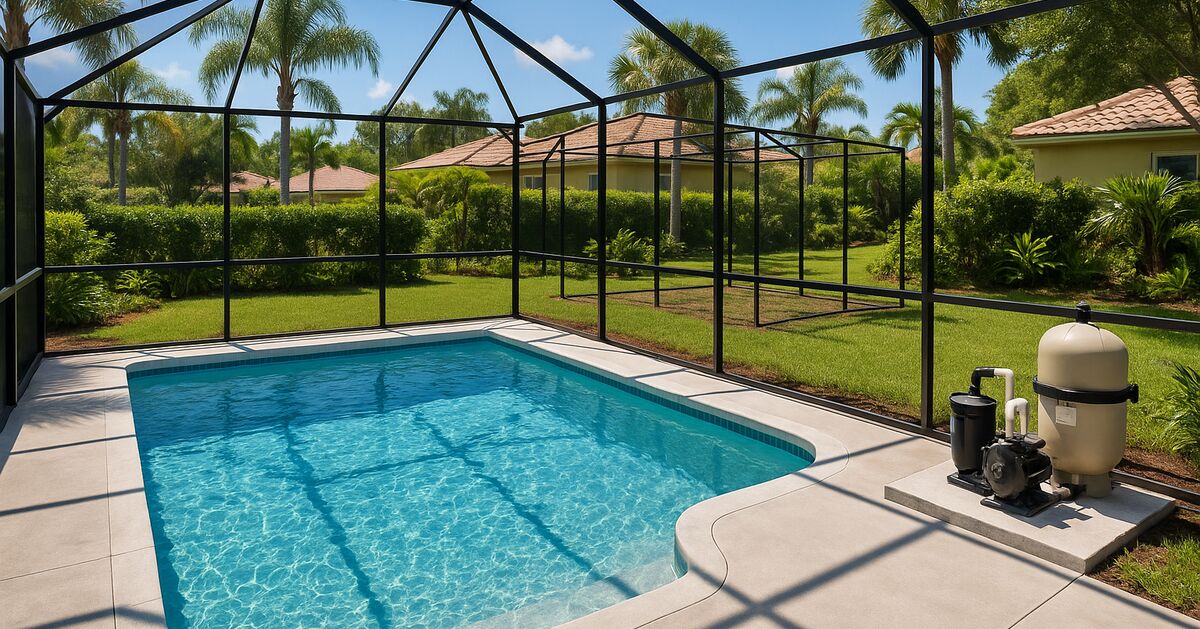
Option 1: An enclosure that meets the code. This is a screen enclosure or solid fence that surrounds the pool and is at least 4 feet tall, has no openings a 4-inch sphere can pass through, and has self-closing, self-latching gates that open away from the pool. The latch must be at least 54 inches above the ground or on the pool side of the gate.
Option 2: An approved pool cover. A power safety cover that meets ASTM F1346 standards. This must be in place whenever the pool is unattended.
Option 3: An alarm system. A combination of door alarms on every door with direct access to the pool area, a surface wave detection system, an underwater motion alarm, or a wearable immersion alarm that meets ASTM F2208. Alarms must sound both at the pool and inside the home.
Option 4: Isolation fencing. A fence that isolates the pool from the home, as opposed to fencing the full yard. This requires no openings a 4-inch sphere can pass through, a minimum 48-inch height, and the same self-latching gate requirements as Option 1.
In practice, the vast majority of Sarasota County pools use some combination of a screened enclosure and door alarms, but the code requires the barrier to be in place (or the cover or alarm to be verified) before the final inspection. Inspectors will test gate latches, measure fence heights, and check that the alarm devices are operational. This is not a paperwork check. They are physically testing it.
Communities in The Meadows, Bee Ridge, and Fruitville that do not have screen enclosure traditions may rely more heavily on fencing, and those projects need careful measurement before construction. A fence that comes in at 46 inches instead of 48 inches will fail.
Electrical bonding and GFCI: what inspectors actually check
The electrical portion of a pool permit gets its own inspection, sometimes two separate visits, and it is often the stage where projects stumble.
Equipotential bonding is required around the entire pool. The bonding grid ties together the pool shell reinforcement, all metal equipment (pumps, heaters, filters, rails, ladders), all metal within 5 feet of the water's edge, and the water itself via a bonding lug in the circulation system. The purpose is to eliminate voltage differences between conductive surfaces that a swimmer could bridge with their body. This is not the same as grounding. Bonding keeps everything at the same potential. Grounding takes fault current to earth. Both are required, and they serve different purposes.
GFCI protection is required for all receptacles within 20 feet of the pool edge and for all lighting circuits. Any underwater lighting operating above 15 volts must be GFCI protected. The luminaire (light fixture) must be listed for underwater use and must be installed at the correct depth, with a conduit that allows the fixture to be removed for service without draining the pool.
The disconnect must be located within sight of the pool equipment and at least 5 feet from the water's edge.
When the electrical inspector visits, they will pull covers, physically test GFCI devices, trace bonding conductors, verify the equipment ground, and look at the panel schedule to confirm circuit sizing. A missing bonding connection on a single ladder rail is enough to fail the inspection. If you have already had an inspection fail on another project, Sarasota County inspection failures: causes and how to reschedule fast covers the rescheduling process and what to have corrected before the re-inspection.
The inspection sequence for a pool permit
Sarasota County pool projects typically go through the following inspection stages. The exact sequence can vary based on whether the project includes a spa, screen enclosure, or deck, but this is the general order.
- Pre-pour (steel) inspection. Before the shell is gunited or poured, the inspector verifies that the reinforcement steel layout matches the engineered drawings. Bar spacing, size, clearances from the shell surface, and the bonding conductor connections to the steel are all checked at this stage.
- Rough electrical inspection. Conduit runs, panel connections, bonding grid, and equipment connections are inspected before anything is covered. This is typically done before the deck is poured.
- Barrier inspection. The fence, enclosure, or other barrier system is inspected for compliance with Florida Statute 515. This must pass before the pool can be filled.
- Final pool inspection. The completed pool and all equipment are inspected. The inspector verifies GFCI operation, equipment installation, water chemistry documentation (where applicable), and barrier operability. The pool cannot be used until this inspection passes.
- Final electrical inspection (sometimes combined with the final pool inspection, sometimes separate depending on the inspector assignment).
If your project includes a spa, screen enclosure, or gas heater, additional inspections may be required. Screen enclosures have their own permit and their own inspection sequence. If you are adding a gas heater, the gas line requires a separate rough and final inspection. Plan for five to eight inspection events on a full pool and enclosure project.
Setbacks, easements, and other site issues that trip up applications
Several site-specific issues cause pool permit applications to get kicked back before review even starts.
Utility easements. Rear yard utility easements in many Sarasota County neighborhoods are 7.5 to 10 feet wide. You generally cannot place any permanent structure, including a pool shell, inside an easement. A pool on a lot with a 10-foot rear easement and a 5-foot setback requirement needs to sit at least 15 feet from the rear property line. Many homeowners do not realize this until the site plan comes back with a comment.
Septic systems. Properties in Osprey, Nokomis, and parts of Fruitville and Bee Ridge that are still on septic systems must locate the pool a minimum distance from the drainfield and tank. The Florida Department of Health has jurisdiction over setbacks from septic components, and a pool permit will not be approved without DOH sign-off if the property has a septic system. This adds a step to the process that fully sewered properties skip entirely.
Flood zones. Sarasota County has significant FEMA flood zone coverage, including AE and VE zones in coastal areas like Siesta Key and Osprey. Pools in these zones may need to be designed as breakaway structures or meet specific anchoring requirements so they do not float or shift during a flood event. The site plan must reference the Base Flood Elevation and show that the pool deck and equipment pad are compliant.
HOA approvals. In Palmer Ranch and The Meadows, the HOA approval is a separate process from the county permit. HOA approval does not substitute for a county permit, and a county permit does not override HOA restrictions. Both must be in hand before construction begins.
For a broader look at what can cause a permit application to come back before it even gets to a reviewer, why Sarasota County permits get kicked back and how to submit right the first time is worth reading before you submit.
How long does a pool permit take?
Under Sarasota County's standard review process, a complete residential pool permit application should receive a first comment or approval within 30 business days for a standard over-the-counter submission. In practice, applications that are missing documents, have setback questions, or need DOH coordination can take considerably longer. If your project is on a septic-served lot or in a flood zone, add two to four weeks for the additional agency reviews.
Concurrent review, where building and other departments review simultaneously rather than sequentially, is available for certain project types. Sarasota County's concurrent review process: building and zoning explained explains how that works and when it is worth requesting.
If you want a realistic timeline calibrated to current county workload, how long does a permit take in Sarasota County, really? breaks it down by project type and time of year.
A note on spa-only permits
A standalone spa, whether an in-ground gunite spa or a factory-built portable spa installed as a permanent fixture, follows a similar but sometimes abbreviated permit process. Portable spas that are truly portable (plug-in, not hardwired, and not permanently installed) generally do not require a permit, but once you hardwire a spa or connect it to a 240-volt dedicated circuit, a permit is required. In-ground spas attached to a pool are typically permitted on the same pool permit. Freestanding in-ground spas have their own shell inspection requirements.
The barrier requirements of Florida Statute 515 apply to spas as well as pools. A spa that a toddler can access is treated the same as a pool for barrier purposes.
Working with a permit expediter
A pool permit application is one of the more document-intensive residential permits Sarasota County processes. The engineering package, the electrical plans, the site plan with easement overlays, the DOH coordination if applicable, and the product approvals all need to be complete and consistent with each other before the application is accepted. A single discrepancy between the site plan dimensions and the engineering drawings is enough to generate a comment that costs two weeks.
A permit expediter who works with Sarasota County regularly knows the current comment patterns, knows what the reviewers are looking for, and can flag problems in the package before it goes in rather than after. If you want to understand the service and how it applies to pool projects specifically, our permit expediting services page explains the process in plain language.
You can also contact us directly if you have a specific project and want a straightforward answer about timing and what will be needed.
Summary
Permitting a pool or spa in Sarasota County involves structural engineering review, a barrier compliance inspection under Florida Statute 515, a detailed electrical inspection covering bonding and GFCI, and a multi-stage inspection sequence that must be completed in order. Setback requirements, utility easements, septic setbacks, and flood zone compliance add layers that vary by location. Getting the application package complete and correct before submission is the single most effective way to keep the project on schedule.
If you are in Sarasota, Siesta Key, Palmer Ranch, or any of the surrounding communities we serve, and you want help navigating the process, we are here to make it straightforward.
Start here
Tell us about your permit
A real local person reads every request and replies with a clear next step, usually the same business day. No cost, no obligation.