Resolving a Sarasota County environmental permit flag before building review starts
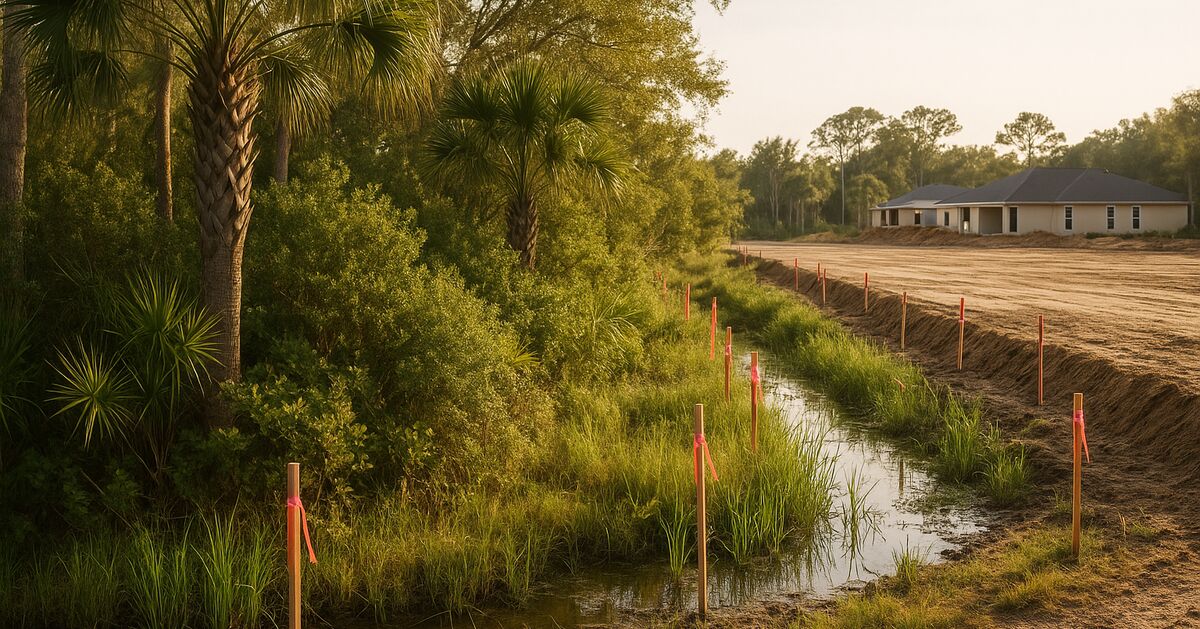
Your permit application lands in the Sarasota County system, and before a building plans examiner ever opens your drawings, it gets stopped. The hold does not come from Building and Development Services. It comes from a completely separate office, the Environmental Permitting Division, and until that office signs off, the construction review queue will not even start the clock on your project.
This is one of the most frustrating surprises homeowners and contractors encounter in the local permitting process. It is also one of the most preventable. Understanding why environmental review happens, what triggers a flag, and what it actually takes to clear one can save you weeks of calendar time and a lot of unnecessary back-and-forth.
Why Sarasota County runs environmental review before building review
Sarasota County's Environmental Permitting Division sits within the Public Works department, not within Building and Development Services. The two departments coordinate through a parallel or "concurrent" routing process: when a permit application arrives, the system automatically routes it to several reviewers at once, including environmental staff.
The reason environmental review comes first in practice (even if technically concurrent) is that an environmental hold blocks final approval regardless of where building review stands. A project can sail through plans examination and still be unable to receive its permit because the environmental desk has not cleared it. Clearing the environmental flag is a prerequisite, full stop.
The division is responsible for protecting Sarasota County's wetlands, floodplains, surface water, groundwater, native vegetation buffers, and coastal resources. The rules that govern their review come from multiple layers: Chapter 54 of the Sarasota County Code of Ordinances (Natural Resources), Florida Statutes Chapter 373 (water resources), and applicable state and federal regulations administered through the Southwest Florida Water Management District (SWFWMD) and, for coastal projects, the U.S. Army Corps of Engineers.
What actually triggers an environmental flag
Not every permit gets a substantive environmental review. The routing is largely automated based on project type, parcel characteristics, and mapped overlays. Here are the situations that most commonly trigger a flag.
Mapped wetlands or surface water on or near the parcel. Sarasota County maintains a wetland inventory layer. If any portion of your parcel overlaps that layer, even partially, environmental staff will look at the project footprint carefully. You do not have to be proposing work in the wetland itself. Work within the required buffer (typically 25 to 50 feet depending on wetland type and location, per County code) can still trigger review.
Tree removal or land clearing. Chapter 54 of the County code includes a native vegetation protection component. Clearing more than a threshold area of native vegetation, or removing specific protected tree species, requires a separate environmental authorization before building can proceed. Grand oaks, cabbage palms, and certain upland scrub species get particular attention.
Projects near or within the 100-year floodplain. Floodplain work intersects with both environmental review and building review. Fill placed in a floodplain has to be compensated by equivalent cut to preserve floodplain storage volume. Environmental staff review the grading plan for compliance with this requirement independently of how the building department evaluates the structure itself. If you are working in Palmer Ranch, Gulf Gate, or any of the low-lying corridors off Fruitville Road, floodplain overlap is common enough to plan for.
Coastal, estuarine, or mangrove-adjacent sites. Properties on Siesta Key, in Osprey, or along Little Sarasota Bay in Nokomis are frequently in Coastal High Hazard Areas and may have jurisdictional wetlands that also fall under state or federal authority. Work that touches mangroves triggers a hard stop because mangrove trimming and removal in Florida is governed by Florida Statutes Section 403.9321 and requires specific state authorization before county review can conclude.
Stormwater and impervious surface increases. Adding impervious area (a new driveway, an addition, a pool deck) beyond the thresholds in the County's stormwater regulations requires demonstrating that the site can still manage runoff consistent with County and SWFWMD requirements. Environmental staff review this for sites that are not already covered by a master drainage permit.
Sites with prior environmental enforcement history. If the parcel has a prior unpermitted clearing violation, an open enforcement case, or a prior mitigation agreement on record, any new permit application will automatically receive heightened environmental scrutiny.
Reading the flag: what the comment actually says
When environmental review issues a comment or hold in the County's permitting portal (Sarasota County uses an online system for application tracking), the comment is usually specific. Common language you will see includes:
- "Wetland determination required prior to permit issuance."
- "Native vegetation inventory and preservation plan required."
- "Stormwater management plan must demonstrate compensating storage for fill in floodplain."
- "Mangrove trimming authorization from FDEP required."
- "Tree removal permit required. Contact Natural Resources."
- "Environmental site plan must show 50-foot wetland buffer with no encroachment."
Each of these comments points to a specific deliverable. The mistake many applicants make is treating the comment as a general flag to be argued away rather than a checklist item to be fulfilled. The reviewer is not asking a question. They are telling you exactly what documentation or authorization is missing.
If the comment references an outside agency (SWFWMD, FDEP, Army Corps), that agency's approval must be obtained separately and then submitted to the County as supporting documentation. The County cannot waive a state or federal requirement, and the environmental reviewer cannot move forward without evidence of the outside agency's sign-off.
Step-by-step: how to actually resolve the flag
Step 1: Request a pre-resolution conversation with the environmental reviewer. Every comment in the County portal is assigned to a specific staff person. Call or email that reviewer directly. Ask two questions: exactly what document format or content do you need, and is there anything in my existing submittal that partially addresses the concern. This call typically saves at least one full correction cycle.
Step 2: Hire the right consultant for the specific issue. A wetland determination must be performed by a qualified environmental consultant and, depending on the situation, may need to be confirmed by SWFWMD. A stormwater compensating storage calculation is engineering work. A tree survey must identify species, DBH (diameter at breast height), and condition. Matching the right professional to the specific flag matters because submitting a document that does not meet the required technical standard will result in another comment, not a clearance.
Step 3: Pursue any outside agency authorizations in parallel. If the flag requires an FDEP Individual or General Permit, or a SWFWMD Environmental Resource Permit (ERP), start that application immediately. State agency review timelines vary, and applicants should confirm current estimates directly with FDEP or SWFWMD, since simple general permits tend to move faster than complex individual permits. Running that process in parallel with County review, rather than waiting to see if the County clears first, is the single biggest time-saver available to you.
Step 4: Resubmit a complete, organized response package. When you resubmit to the County, organize the response so it directly mirrors the comment. If there were three comments, address each one explicitly, in order, and label your attachments to correspond. Environmental reviewers handle many applications and a clear, organized response package makes the re-review faster.
Step 5: Follow up on the re-review turnaround. County environmental review has its own clock, separate from building review. Once you resubmit, the system typically triggers a new review period. Check the portal, and if the review period has elapsed without action, a polite follow-up call to the reviewer is appropriate. Reviewers are generally accessible and responsive.
Common mistakes that make environmental flags worse
A mistake that comes up again and again with owners and contractors navigating this process is submitting a revised site plan to the building department without simultaneously updating the environmental reviewer. The two reviewers look at different things, but they both look at the site plan. If your revised plan changes the footprint, grading, or tree disposition from what the environmental reviewer has on file, the environmental review effectively resets.
Another frequent issue is assuming that a prior owner's environmental permit or mitigation agreement covers a new project. It may not. Environmental authorizations are typically tied to a specific scope of work. A new addition or a different grading configuration is a new scope, and the prior authorization cannot be assumed to extend to it.
Sites in The Meadows and Bee Ridge sometimes have legacy drainage easements or deed-restricted buffers that do not show up clearly in a title search but are recorded in County environmental records. Environmental staff will flag a project that proposes work within one of those areas even if the applicant had no idea the restriction existed. Pulling the parcel's environmental records before you submit, not after you receive the flag, is always worth the effort.
For a broader picture of what the County's review process looks like across departments, our post on Sarasota County's concurrent review process: building and zoning explained covers how the lanes interact. And if your project is in a flood zone and you are dealing with both environmental and elevation-related complications, the issues compound quickly, something our permit expediting services team handles regularly.
How long does resolving an environmental flag take?
There is no single answer, because it depends entirely on what the flag is for. A straightforward tree removal permit for a non-protected species, once properly documented, can be cleared within a few business days. A wetland boundary determination, followed by a mitigation plan, followed by a SWFWMD ERP, can take a significant amount of time, so applicants should check current timelines with SWFWMD. A mangrove authorization from FDEP adds its own timeline on top of that.
The practical implication is that if your project has any of the triggers described above, the time to engage environmental review is before you submit your building permit application. Many experienced local contractors and permit expediters request a pre-application meeting with the Environmental Permitting Division to identify likely issues and start the documentation process early. That investment of time at the front end consistently shortens overall project timelines.
If you are unsure whether your parcel has environmental overlays, Sarasota County's online GIS portal includes layers for wetlands, FEMA flood zones, coastal high hazard areas, and native vegetation. Reviewing those layers for your specific parcel address before you design the project, rather than after, is where the prevention happens.
Environmental holds, code enforcement, and title issues
An unresolved environmental hold on an open permit can compound into other problems. If a project proceeds without the required environmental authorization and the work is discovered, the result can be a code enforcement case that results in a lien on the property. Our coverage of Sarasota County code enforcement liens: how they attach and how to get them released explains how quickly that situation can escalate, particularly when a property sale is on the horizon.
Environmental violations tied to wetland or mangrove impacts may also carry state-level consequences independent of County code enforcement, such as restoration requirements or penalties, so it's worth checking directly with FDEP about enforcement possibilities.
When you are purchasing a property and discover an open permit with an unresolved environmental comment, the due diligence process requires understanding what that comment requires before you can estimate the cost or timeline to close it. Our guide on how to read a Sarasota County permit history report walks through how to find and interpret that history.
Working with a permit expediter on environmental flags
Environmental flags are not a dead end, but they do require a different skill set than standard building permit navigation. A permit expediter who knows the Sarasota County Environmental Permitting Division staff, understands which consultants produce documentation in the formats reviewers accept, and can track parallel state and County review timelines adds real, measurable value in these situations.
Our team works across all of the communities we serve, from Siesta Key coastal projects to inland sites in Fruitville and the Bee Ridge corridor, and we have worked through the full range of environmental flag types described in this post. If you are dealing with a flag right now or want to assess your project's environmental exposure before you submit, reach out to us and we can walk through what your parcel's records show.
You can also browse our full FAQ for answers to common questions about the Sarasota County permitting process, or explore the rest of our blog for topic-specific guides on everything from impact fees to inspection failures.
Environmental flags feel like bureaucratic obstacles, and the frustration is understandable. But each one points to a real resource the county (and state) is trying to protect: wetlands, trees, floodplain storage capacity, coastal habitat. Clearing the flag is not about fighting the system. It is about giving the reviewer the specific documentation they need to confirm your project works within those protections. Do that, and the path forward opens up.
Sources & further reading
- Florida Statutes Chapter 373 - Water Resources (Florida Legislature)
- Florida Statutes Chapter 403 - Environmental Control (Mangrove Trimming) (Florida Legislature)
- Florida Department of Environmental Protection - Wetlands and Mitigation (Florida Department of Environmental Protection)
- Federal Emergency Management Agency (named in this article) (Federal Emergency Management Agency)
Claim-by-claim audit (5 checked)
- “Work that touches mangroves triggers a hard stop because mangrove trimming and removal in Florida is governed by Florida Statutes Section 403.9321 and requires specific state autho…” (cited → flsenate.gov)
- “State agency review timelines vary, and applicants should confirm current estimates directly with FDEP or SWFWMD, since simple general permits tend to move faster than complex indi…” (rewritten to what the article can stand behind)
- “A wetland boundary determination, followed by a mitigation plan, followed by a SWFWMD ERP, can take a significant amount of time, so applicants should check current timelines with …” (rewritten to what the article can stand behind)
- “If a project proceeds without the required environmental authorization and the work is discovered, the result can be a code enforcement case that results in a lien on the property.” (reasoning shown in the article)
- “Environmental violations tied to wetland or mangrove impacts may also carry state-level consequences independent of County code enforcement, such as restoration requirements or pen…” (rewritten to what the article can stand behind)
Start here
Tell us about your permit
A real local person reads every request and replies with a clear next step, usually the same business day. No cost, no obligation.