Permitting a kitchen or bathroom remodel in Sarasota County: what's really required
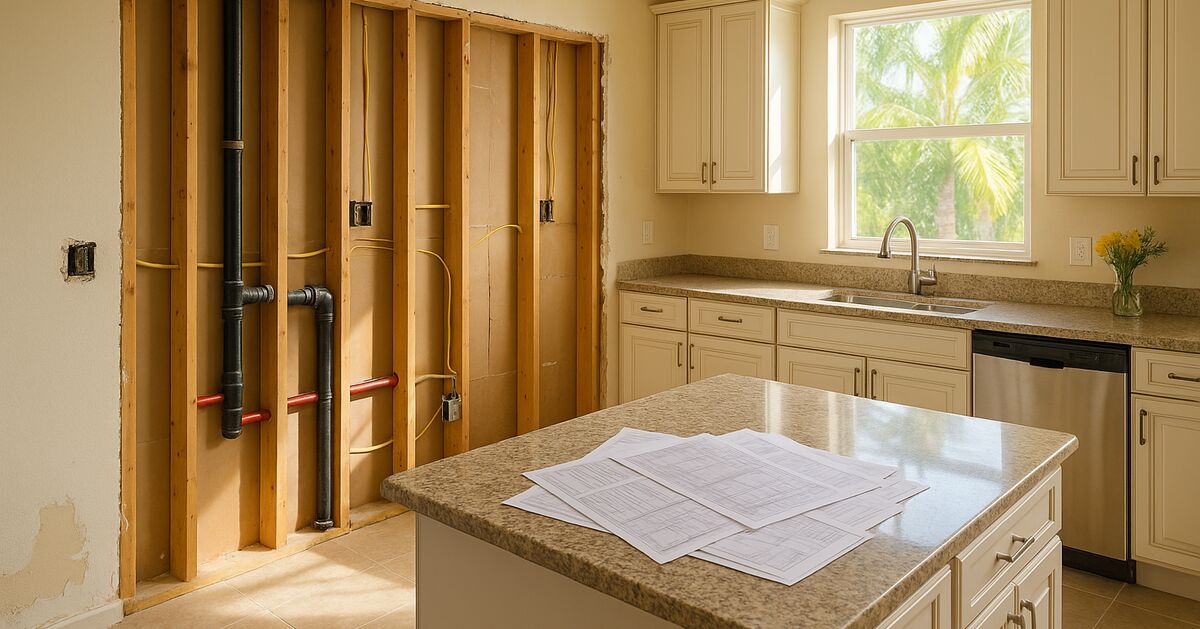
Moving a single wall in a Sarasota kitchen can quietly pull in four separate trade permits before the drywall goes back up. Most homeowners don't realize this until their contractor is already on-site and the project scope has doubled on paper.
Kitchen and bathroom remodels sit in a peculiar middle ground in Florida's building code world. They feel like interior work, private and contained, but they touch nearly every regulated system in a house: structure, electrical, plumbing, mechanical ventilation, and sometimes even fire protection. Sarasota County's building department treats them accordingly. Understanding exactly what triggers a permit, and where the scope tends to grow beyond what owners expected, can save you weeks of delay and real money.
The baseline: when does a kitchen or bathroom remodel need a permit at all?
The short answer is that cosmetic-only work does not require a permit. Replacing cabinet doors, swapping a faucet for one with the same connection points, painting walls, installing new flooring that sits on top of existing subfloor, or hanging light fixtures on existing circuits, these tasks generally fall below the threshold. No structural change, no relocation of pipes or wires, no new penetrations through exterior walls or the roof.
The permit line gets crossed the moment you touch one of these categories:
- Electrical work beyond a simple fixture swap. Adding an outlet, moving a circuit, installing a new dedicated circuit for a dishwasher, refrigerator, microwave, or disposal, or upgrading a panel to support new loads all require an electrical permit in Sarasota County.
- Plumbing relocation or addition. Moving a sink, adding a second basin, relocating a toilet, roughing in a new shower, or touching the drain-waste-vent (DWV) stack triggers a plumbing permit.
- Mechanical ventilation changes. Installing or rerouting exhaust fans that penetrate an exterior wall or the roof requires a mechanical permit. This catches a lot of homeowners off guard.
- Structural modifications. Removing or modifying a wall, even a non-load-bearing one in some configurations, widening a doorway, or altering the floor framing to drop a subfloor for a tile shower pan all require a building permit.
- Gas line work. Adding or relocating a gas range hookup, running a new line to a tankless water heater in a renovated utility closet, or capping and extending existing gas requires both a plumbing permit and a gas inspection.
In practice, a full kitchen remodel almost always requires at minimum an electrical permit and often a plumbing permit too. A bathroom gut-and-redo almost always requires both, plus a mechanical permit for the exhaust fan if it is being replaced or rerouted.
The trades that pile up: why "one job" often means multiple permits
Here is where homeowners consistently underestimate scope. Sarasota County issues permits by trade, not by project. Your contractor may submit a building permit application that references electrical and plumbing sub-permits, but each trade gets its own permit number, its own inspections, and its own sign-off. If your electrical subcontractor finishes but your plumber is delayed, the electrical inspection can proceed independently, but your certificate of completion (or occupancy, depending on project type) will not issue until every open sub-permit is closed.
Our post on CO vs. CC in Sarasota County: which certificate your project needs and why it matters goes into detail on how these certificates work. For a remodel, you are almost always looking for a Certificate of Completion rather than a Certificate of Occupancy, but the multi-trade coordination challenge is identical.
A realistic permit list for a full primary bathroom renovation might look like this:
- Building permit (structural framing for a new shower niche, subfloor modification)
- Plumbing permit (shower relocation, new valve, DWV rough-in)
- Electrical permit (GFCI outlets, exhaust fan circuit, vanity lighting circuit)
- Mechanical permit (new exhaust fan penetrating exterior wall)
That is four permits, four sets of inspections, and four sign-offs before the job is done in the county's eyes. Miss one and you have an open permit sitting on title, which becomes your problem at sale. Our colleagues in the permit world deal with that scenario regularly, and it is never a comfortable conversation at closing.
What Sarasota County inspectors actually look at during a kitchen remodel
Understanding inspections helps you understand why the county requires permits in the first place. These aren't bureaucratic checkboxes. They protect the occupants of the home.
Electrical inspections for kitchens focus heavily on the 2020 NEC (National Electrical Code) requirements Florida has adopted. Kitchen countertop circuits must be AFCI-protected and on dedicated 20-amp circuits. Outlets must be spaced correctly along the countertop so no point is more than two feet from a receptacle. GFCI protection is required within six feet of a sink. The inspector will also verify that the range or cooktop circuit, typically 240-volt, is properly sized.
Plumbing rough-in inspections happen before the walls close. The inspector checks that new drain lines have the correct slope (generally 1/4 inch per foot for horizontal runs), that cleanout access is provided, that vent connections are proper, and that the water supply lines are the right material and diameter. In Sarasota County, polybutylene pipe (the gray flexible pipe common in homes built from the 1970s through the mid-1990s) cannot be extended. If your remodel exposes it, you may be required to replace the run.
Tile shower systems get particular attention. Florida's building code requires a shower pan liner or a code-approved pre-formed base. If you are building a custom tile shower, there is typically a flood test: the pan liner is filled with water and held for 24 hours before tile is set. The inspector must witness the test or approve an alternative. Many contractors skip ahead and set tile early, then have to tear it out. Do not let that happen on your project.
Mechanical inspections for exhaust fans check that the duct terminates properly at the exterior (not into an attic), that it is insulated in unconditioned spaces, and that the fan is rated for continuous or intermittent use as appropriate. Venting into the attic is a very common code violation that gets flagged in both permit inspections and home inspections at resale.
Where homeowners in Sarasota most commonly underestimate scope
After years of helping homeowners and contractors navigate the county's process, a few patterns show up repeatedly.
The "while we're at it" problem. A homeowner budgets for a cabinet replacement and new countertop, no permit needed. Then the contractor opens the wall to fix a slow drain and finds that the original plumbing is in poor shape. The scope grows. Now you have new drain lines, a relocated cleanout, and a plumbing permit. The budget and timeline both shift, and the homeowner feels blindsided even though the work was genuinely necessary.
Older homes in Gulf Gate, Bee Ridge, and Fruitville. Many homes in these neighborhoods were built in the 1960s and 1970s with 60-amp or 100-amp electrical services and aluminum branch wiring. A kitchen remodel that adds a couple of dedicated circuits may reveal that the existing panel cannot safely accommodate them. An electrical upgrade, sometimes a full panel replacement, gets added to the scope. Permit expediting in Bee Ridge and surrounding areas often involves helping owners navigate exactly this kind of scope creep at the permitting stage.
Siesta Key and coastal properties. Homes on or near the water often have additional overlay considerations. Wind-borne debris requirements under the Florida Building Code are more stringent in high-velocity hurricane zones. If your remodel involves replacing a window or adding one, even in a bathroom, you may be in wind zone territory that requires impact-rated glazing. Work in Siesta Key specifically may also touch flood zone requirements depending on the home's elevation and FEMA flood map designation.
The Meadows and Palmer Ranch HOAs. Remodeling in communities like The Meadows or Palmer Ranch adds a layer beyond the county building department. HOA architectural review boards may require approval for scope that changes plumbing locations (because it can affect shared walls or association infrastructure in attached units), or for anything that changes the exterior appearance of the home, including where a new exhaust fan terminates on the wall. County permits and HOA approvals are separate processes and neither waives the other.
The unpermitted prior work problem. This one is particularly common in bathrooms. A previous owner had a shower retiled or a vanity moved without permits. You hire a contractor to update the space, they pull permits, the inspector arrives, and spots the prior non-code work. Now your project includes legalizing someone else's shortcut. This is related to a broader challenge we cover in our post on unpermitted work found by Sarasota County: what happens next and how to get ahead of it, and the earlier you surface these issues, the better your options.
How the permit application process works in Sarasota County
Sarasota County uses an online permitting portal for most residential applications. Your contractor submits the application, uploads plans (for structural work, stamped drawings may be required; for purely trade work, a diagram often suffices), and pays the applicable fees. The application goes into plan review, where building, zoning, and trade reviewers may comment. If comments come back, the applicant revises and resubmits.
For a straightforward bathroom remodel with no structural changes, the plumbing and electrical permits may be issued over the counter or within a few business days electronically. Once permits are issued, your contractor posts the permit on-site, schedules work, and calls for inspections at each required stage.
Inspections are typically requested online or by phone and are usually available within one to three business days, though that can vary with the department's caseload. Failed inspections require a re-inspection, which adds time. Coordinating inspections across multiple trades, and making sure each one happens in the right sequence, is one of the real logistical challenges of a multi-trade remodel. Our permit expediting services are specifically designed to manage that coordination so contractors and homeowners aren't losing days to scheduling gaps or missed re-inspections.
What to watch for after the work is done
A permit is not closed when the last trade finishes work. It is closed when the final inspection passes and the county issues the Certificate of Completion. Until that happens, the permit remains open on the property record.
Open permits create problems at resale. Title companies and buyers' attorneys routinely search permit records. An open permit from a remodel you completed three years ago can delay or kill a closing. If you are in Osprey or Nokomis and have had remodel work done recently, it is worth logging into the county's public permit portal and checking whether your permits show a "Finaled" or "Completed" status. If they don't, you want to know now, not during a sale. You can also check our frequently asked questions page for guidance on how to interpret county permit records.
If a contractor left a project with open permits, the path forward is specific and sometimes complex. Our post on how to close a stalled permit in Sarasota County when the contractor is gone walks through the options in detail.
A practical approach for planning your remodel
The most useful thing you can do before signing a contractor agreement is to have an honest conversation about which permits will be required and who is responsible for pulling them. In Florida, the licensed contractor is generally required to pull permits for work in their trade. An unlicensed handyman cannot pull a building permit on your behalf. If someone tells you the work "doesn't need a permit" and you're not sure, get a second opinion before work begins. Retroactively permitting completed work is more expensive and more disruptive than permitting it upfront.
If your project is in Sarasota proper, note that the City of Sarasota building department is separate from Sarasota County, with its own review process. Projects in the city of Sarasota go through the city, not the county. Getting this right matters from day one.
For homeowners across the county's service area, from Fruitville in the northeast to Osprey and Nokomis in the south, the permitting rules are consistent under the county umbrella, but local nuances (flood zones, HOAs, older infrastructure) mean every project has its own wrinkles. If you want help mapping out what your specific remodel will require before your contractor submits anything, get in touch and we can walk through it with you.
Knowing the scope of your permit obligations at the start of a project is not a limitation. It is what keeps the project on schedule, protects your investment, and makes sure the work you paid for adds real value to your home rather than a liability on the title.
Start here
Tell us about your permit
A real local person reads every request and replies with a clear next step, usually the same business day. No cost, no obligation.