Permitting a dock, seawall, or boat lift in Sarasota County
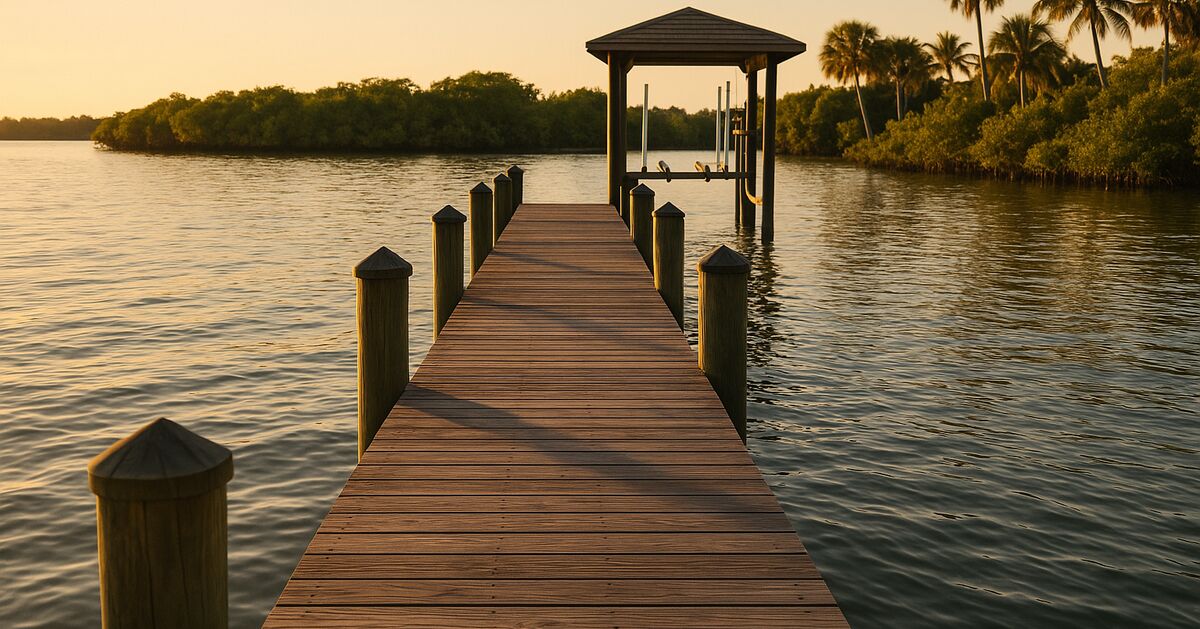
Getting a dock, seawall, or boat lift permitted in Sarasota County is genuinely more involved than almost any other residential project a homeowner will tackle. It is not just a building permit. It is a building permit layered on top of environmental review, possible state coordination, and in some cases federal sign-off, all running at the same time or in sequence depending on where your property sits. Knowing what each agency wants, why they want it, and in what order to give it to them is the difference between a project that moves in a few months and one that stalls for a year.
This guide walks through every approval layer specific to Sarasota County waterfront projects, what triggers each one, and the practical mistakes that send applications back to square one.
Why waterfront permits are different from every other home project
A new bathroom addition or a room conversion lives entirely on your private property and affects only your structure. A dock, seawall, or boat lift extends into, or directly borders, state-owned submerged lands and navigable waterways. That changes everything.
Florida considers the water bottoms below mean high water line to be sovereign state lands. When you build over or adjacent to those lands, you are not just asking the county for a building permit. You are asking the state for permission to use land it owns. And if the waterway connects to federal navigable waters, the U.S. Army Corps of Engineers may have jurisdiction too.
On top of that, Sarasota's coastal and inland waterways are home to seagrasses, mangroves, manatees, and fish habitat that are protected under both state and federal law. Every dock or seawall project gets reviewed through an environmental lens that a simple addition project never faces.
Understanding this from the start will save you real time and money. Many homeowners in Osprey, Nokomis, and along the intercoastal areas of Siesta Key have started projects assuming a single permit is all they need, only to discover mid-process that a state environmental resource permit was required all along.
The three main approval layers
1. Sarasota County building permit
The county building department reviews the structural aspects of your project: the dock framing, pilings, decking, the boat lift mechanical system, and the seawall construction or repair. This is the permit most people think of first, and it is necessary for almost every waterfront structure.
For a dock or pier, the building permit application will require:
- A site plan showing the existing shoreline, mean high water line, and proposed structure footprint
- Construction drawings stamped by a Florida-licensed engineer
- Proof that the contractor holds the appropriate license for marine construction
- Verification that the project does not encroach on neighboring riparian rights (typically shown by confirming the structure stays within a 45-degree angle from the side property lines extended into the water)
For a seawall, the county wants to see the existing wall condition, the replacement or repair scope, and engineer-stamped drawings showing the tie-back system, cap design, and any fill activity behind the wall.
Boat lifts are generally attached to an existing or new dock, so the lift itself is added to the dock permit. Freestanding piling-mounted lifts still require a permit showing how the pilings are sized and set.
Our permit expediting services cover the full assembly of county building permit packages for marine structures, including coordinating the required engineer drawings before submission.
2. Florida DEP or Water Management District environmental resource permit (ERP)
This is the layer that surprises most homeowners. The Florida Department of Environmental Protection (DEP) and, depending on location, the Southwest Florida Water Management District (SWFWMD) require an Environmental Resource Permit for construction in, on, or over waters of the state.
Whether you need a standard ERP, a noticed general permit, or an exemption depends on the size and type of your project:
- Single-family dock exemptions exist for certain small docks (typically up to 1,000 square feet of over-water surface and meeting specific design criteria), but they are not automatic. You must self-certify, or in some cases notify the agency, that your project meets all the exemption criteria. Missing a single criterion means you need a full permit.
- Noticed general permits cover a broader range of projects that are still relatively low-impact. They require advance notification to the agency and a waiting period before you begin.
- Individual ERPs are required for larger or more complex projects. The agency reviews these on a case-by-case basis and may require mitigation or design modifications.
The criteria that knock a project out of the exemption category and into the full permit process include: constructing over seagrass beds, building in an Outstanding Florida Water, exceeding size thresholds, or being located in an area with known manatee concentrations. Many waters in Sarasota County, including parts of Little Sarasota Bay, Roberts Bay, and Lemon Bay near Osprey and Nokomis, carry specific manatee protection overlays that add requirements to any project.
Getting the ERP determination wrong is one of the most common reasons waterfront projects in Sarasota County get shut down after construction starts. Do not assume an exemption applies. Confirm it in writing with the agency before any pilings go in.
3. Florida DEP submerged lands lease or letter of consent
Even if your project qualifies for a construction exemption under the ERP process, you still need authorization from the state to use or occupy sovereign submerged lands. This comes in one of three forms:
- Letter of consent for small, single-family docks meeting specific criteria
- Sovereignty submerged lands lease for larger commercial or multi-slip facilities
- Proprietary authorization included with the ERP for projects reviewed under the ERP process
For most single-family homeowners in Sarasota, Gulf Gate, or Palmer Ranch who have waterfront access, a letter of consent is the appropriate instrument. You apply for it through DEP's Division of State Lands, and it is often processed alongside the ERP or exemption determination. The key requirement is that the structure not unreasonably interfere with the public's use of the water.
4. U.S. Army Corps of Engineers (USACE) permit
If your waterway is a navigable water of the United States (most tidal and many inland waters in Sarasota County qualify), the Army Corps has jurisdiction. For small residential docks and repairs, many projects qualify for a nationwide permit (NWP), which is a pre-authorized category that avoids the full individual permit process.
Nationwide Permit 18 (minor discharges) and Nationwide Permit 3 (maintenance) are the ones most commonly applicable to residential waterfront work. To use an NWP, the project must meet all of the permit's general and regional conditions, and in some cases you must notify the Corps district office before proceeding.
If your project does not fit a nationwide permit, you are looking at a standard individual permit process, which adds significantly more time and documentation.
How the approvals interact and in what order
This is where most homeowners and even some contractors get tripped up. The county building permit and the state/federal environmental approvals are separate processes with no automatic coordination between them. You can apply for them simultaneously, but you cannot receive your county building permit and start construction until the environmental authorizations are in place.
The practical sequence looks like this:
- Have a Florida-licensed marine engineer evaluate the site and prepare drawings.
- Submit the county building permit application with those drawings.
- Simultaneously, determine the correct ERP pathway (exemption, noticed general permit, or individual ERP) and submit to DEP or SWFWMD.
- Submit the submerged lands application to DEP Division of State Lands.
- Determine USACE jurisdiction and submit a nationwide permit pre-construction notification if required.
- Once all environmental authorizations are received, they are provided to the county to satisfy conditions on the building permit.
- County issues the building permit. Construction begins.
- County inspections occur during construction, and a final inspection closes the permit.
On a straightforward single-family dock that qualifies for the ERP exemption and a letter of consent, steps 3 through 5 can be completed in four to eight weeks if the paperwork is complete. On a project requiring an individual ERP, you can be looking at six to twelve months or more before a shovel goes in the ground.
If you want a realistic sense of how long county-side review adds to that timeline, our post on how long a permit takes in Sarasota County covers the factors that move that clock faster or slower.
Seawalls: repair vs. replacement vs. new construction
Seawall projects carry their own nuances. The county and state both distinguish between:
- Like-for-like repair (patching, filling voids, grouting): Often the lightest permit burden, sometimes exempt from ERP if no fill is placed waterward of the existing wall.
- Cap replacement or repair: Treated as maintenance if scope is limited; may still need a county building permit depending on structural scope.
- Full seawall replacement: Requires a county building permit and typically triggers DEP review, particularly if the new wall footprint differs from the old one or if fill is involved.
- New seawall where none existed: This is treated as new construction and goes through the full permit and ERP process.
One important point specific to Sarasota County: the county has mapped areas of significant shoreline sensitivity, and projects near mangrove fringes, even for simple seawall repair, can get flagged for additional environmental review. Homeowners in the coastal areas of Nokomis, Osprey, and Siesta Key should anticipate this possibility and build it into their project timeline.
Common mistakes that delay waterfront permits
Assuming the ERP exemption applies without checking. The exemption criteria are more specific than most people realize. Seagrass mapping, water classification, and manatee zone overlays can disqualify a project that looks straightforward on the surface.
Submitting incomplete drawings to the county. Marine construction drawings need to show more than the dock layout. They need mean high water and mean low water lines, adjacent riparian boundary lines, water depth soundings, and details on every structural connection. Missing any of these triggers a correction notice. Our post on why Sarasota County permits get kicked back applies directly here.
Starting work before all approvals are in hand. This is the most serious mistake. Work without a USACE permit on a navigable waterway can trigger a stop-work order, a restoration requirement, and significant penalties. The county can also issue stop-work orders for unpermitted construction, and getting those resolved can take longer than the original permit would have.
Not accounting for riparian rights. Your dock cannot interfere with your neighbor's ability to access their own waterfront. The 45-degree rule is the standard guideline, but in narrow waterways or on irregularly shaped lots, this can be trickier than it looks.
Ignoring manatee protection conditions. In designated manatee priority areas, DEP and USACE often impose conditions on boat lift design, requiring pole stops or other features to prevent manatee injury. If your contractor is not familiar with these requirements in Sarasota County waters, you may find yourself retrofitting the lift after the fact.
What an expediter does for waterfront projects specifically
A permit expediter on a waterfront project is not just handling paperwork. They are coordinating across multiple agencies simultaneously, tracking the status of each authorization, catching deficiencies before they become formal correction notices, and making sure the county building permit application is staged correctly to avoid it expiring while environmental review drags on.
For homeowners in Sarasota, Siesta Key, Palmer Ranch, and Osprey, working with someone who handles these projects regularly means you are not learning the process from scratch while your contractor waits to start.
The FAQ page covers common questions about how the expediting process works and what you should have ready before your first conversation with us.
What to bring to your first conversation about a waterfront permit
Before you talk to a contractor, an expediter, or any agency, it helps to have:
- Your property survey showing the mean high water line if available (your title documents may have one, or your county property appraiser record may show water frontage)
- A rough sketch or description of what you want to build (size, orientation, whether a lift is included)
- Any prior permits on the property for previous dock or seawall work (these matter because they establish what was previously authorized)
- A general sense of the water depth at the end of your proposed dock (if you have it)
You do not need any of this to be final or formal. The goal is to give an engineer and an expediter enough information to do a preliminary agency check and tell you which permits and environmental authorizations your project will realistically require.
Waterfront permitting in Sarasota County is complex, but it is not mysterious once you understand why each layer of review exists. The environmental requirements exist because these waterways are genuinely sensitive and worth protecting. The structural requirements exist because dock and seawall failures cause real property damage and safety hazards. Working with the process rather than around it is how projects get built, get closed out, and stay out of trouble for the long term.
If you are ready to start scoping a dock, seawall, or boat lift project, get in touch with us or explore all of our service areas to see how we cover the Sarasota County waterfront communities where these projects are most common.
Start here
Tell us about your permit
A real local person reads every request and replies with a clear next step, usually the same business day. No cost, no obligation.