Demolition permits in Sarasota County: what triggers one, asbestos sign-offs, and sequencing before new construction
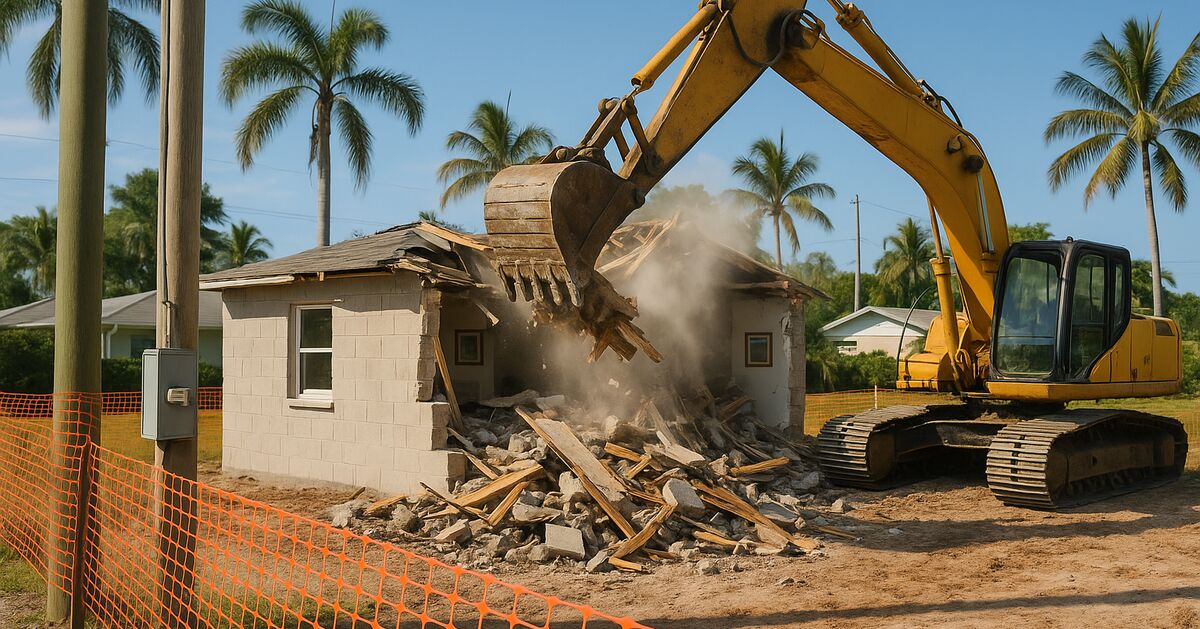
Tear down the wrong wall without a permit in Sarasota County and you can freeze your entire new-construction timeline before a single footing is poured. Demolition feels like the simple part of a project, and in some ways it is, but the permitting side has enough moving pieces that it trips up experienced contractors every season.
This post covers everything a homeowner or builder needs to know: what kinds of work actually require a demolition permit, the environmental clearances that must come before any structural work begins, how utilities get formally signed off, and how to sequence demolition against your future building permit so the two processes reinforce rather than block each other.
What actually triggers a demolition permit in Sarasota County
Not every act of removal rises to the level of a permit. Pulling out old kitchen cabinets, removing a non-structural interior partition, or stripping roofing material down to the deck during a re-roof are all things that typically don't require a standalone demolition permit. But once you cross into these categories, a permit is required:
- Full structure demolition. Tearing down an entire house, detached garage, accessory structure, commercial building, or any enclosed habitable space requires a demolition permit regardless of size.
- Partial structural demolition. Removing load-bearing walls, an entire floor assembly, roof framing, or a substantial portion of the building envelope triggers the permit requirement even when the rest of the structure stays standing.
- Manufactured and mobile home removal. Removing a manufactured home from its site in areas like Fruitville, Bee Ridge, or Gulf Gate requires its own demolition permit, and the title must be retired with the Florida DMV before the county will close the permit.
- Commercial tenant demolition. Any gut renovation of a commercial space that involves removing interior structural elements or MEP (mechanical, electrical, plumbing) systems requires a permit even if the shell stays.
- Pool demolition or abandonment. Removing a pool structure or "abandoning in place" by filling it requires a separate permit because of soil compaction standards and setback implications for future construction.
If you are not sure whether your scope lands on the permit side of the line, the frequently asked questions page is a good starting point, and our team can give you a fast read on the specifics of your project.
The asbestos piece: why it comes first, every time
Florida is one of the stricter states when it comes to asbestos survey requirements before demolition, and Sarasota County enforces those rules through coordination with the Florida Department of Environmental Protection (FDEP) and the U.S. Environmental Protection Agency's National Emission Standards for Hazardous Air Pollutants (NESHAP) regulations.
Here is the practical rule: any structure built before 1980 must have a NESHAP asbestos survey completed by a licensed asbestos inspector before demolition can begin. This applies county-wide, from older ranch homes in The Meadows to mid-century cottages on Siesta Key. Structures built between 1980 and the mid-1990s are also worth surveying because asbestos-containing materials were still in circulation during that window.
The survey must be performed by a Florida-licensed asbestos consultant and produces a written report identifying whether any regulated asbestos-containing materials (RACM) are present. If RACM is found, a licensed asbestos abatement contractor must remove and dispose of those materials before any mechanical demolition begins. The abatement contractor files a notification with FDEP at least ten business days before starting work, and that notification number becomes part of your permit paperwork.
A few specifics homeowners often miss:
- Friable vs. non-friable asbestos. Friable materials (those that crumble by hand) have stricter removal requirements than non-friable materials like intact floor tiles. Your inspector's report will classify each material found.
- The survey covers more than you expect. Pipe insulation, duct wrap, floor tile and mastic, roof shingles, exterior stucco, popcorn ceilings, and joint compound can all test positive. A thorough inspector will sample everything suspicious.
- Abatement timing matters. The FDEP ten-day notification window means you should schedule your survey and abatement contractor early. Waiting until you have a demo permit in hand often adds two to three weeks you did not budget for.
- Lead paint is separate. NESHAP doesn't regulate lead paint the same way, but EPA's RRP (Renovation, Repair, and Painting) rule does apply to pre-1978 residential structures. Your demo contractor should be RRP-certified if the project disturbs painted surfaces.
Utility disconnections and sign-offs required before demolition
Sarasota County Building Inspections requires evidence that utilities are properly disconnected before a demolition inspection will be passed. This is not just a courtesy to the next crew, it is a safety and legal requirement. Here is what needs to happen:
Electrical
Florida Power and Light (FPL) must physically disconnect and remove the meter before any demolition begins. You or your contractor contacts FPL directly to schedule the disconnect. For the permit, the inspector typically wants to see that the service entrance has been cut and the meter pulled. Some inspectors also want conduit caps or the service entrance sealed to prevent re-energizing.
Gas
If the structure has natural gas service through Peoples Gas (formerly TECO), the service line must be disconnected and capped at the main. Peoples Gas has its own disconnect process and will issue a written confirmation. Keep that documentation, as the inspector may ask for it.
Water and sewer
Sarasota County Utilities (or the applicable municipal utility if you are in the City of Sarasota) handles water and sewer disconnections. The service must be terminated at the meter, and the meter itself is typically pulled by the utility. For sewer, the lateral must be capped at the property line or at the main, depending on whether a new structure will eventually reconnect. If you plan to reuse the existing lateral for new construction, discuss that with the utility before capping, because reopening a capped lateral later adds cost and time.
Well and septic (common in Osprey and Nokomis)
Properties on private well and septic, which is common in Osprey, Nokomis, and parts of unincorporated Sarasota County, have additional steps. The well must be properly abandoned by a licensed well contractor per Chapter 62-532 of the Florida Administrative Code, with a well abandonment report filed with the Southwest Florida Water Management District (SWFWMD). The septic system must be abandoned under a separate permit from the Sarasota County Environmental Health office, which involves pumping the tank, collapsing and filling it, and filing a closure report.
Do not skip the septic closure permit. It is one of the most common reasons demo inspections fail in rural parts of the county.
How to apply for the demolition permit itself
Sarasota County accepts demolition permit applications through its online permitting portal. The application is generally straightforward, but make sure you have the following ready before you start:
- Property address and parcel identification number (PIN)
- Contractor license information (licensed general contractor, building contractor, or demolition contractor required for most full-structure demos)
- Scope of work description (full demo vs. partial, structures to remain, etc.)
- Asbestos survey report or signed affidavit that the structure was built after 1986 and is exempt
- Utility disconnection confirmation or a plan for how disconnections will be handled prior to inspection
- Site plan showing the footprint of structure(s) to be removed and any structures to remain
- Tree survey or tree protection plan if significant trees are near the demolition zone
Permit fees for demolition are based on the valuation of the demolition work itself, which the county calculates using a standardized formula. The fee is typically modest compared to a construction permit, but you will also pay for the required inspections.
Our permit expediting services include handling demolition permit applications, which is particularly useful when the demo is the first phase of a larger project and timing is critical.
The inspection sequence for a demolition permit
Once the permit is issued, you do not simply schedule a final demo inspection after the debris is gone. Sarasota County typically requires:
- Pre-demolition inspection. The inspector confirms that utility disconnections are complete and the asbestos abatement clearance (if applicable) is on file before any structural work begins. Skipping this step is the single most common cause of demo permit problems.
- In-progress inspection (for larger or phased demos). Not always required for simple residential teardowns, but common for commercial demolition or partial demos where sequencing matters.
- Final demolition inspection. Confirms the structure is removed, the site is rough-graded, the slab (if left in place per the permit) is in the condition specified, and any open excavations are properly handled.
Once the final inspection passes, the demolition permit closes. That closure record is important for your next step.
Sequencing demolition against your new construction permit
This is where many projects lose weeks or even months, and it is entirely avoidable with a little planning.
Apply for both permits together, but don't expect them to move together. Sarasota County allows you to submit a demolition permit application and a building permit application simultaneously. The building permit will go through plan review while the demo permit processes. However, the county will not issue the building permit until the demolition permit is finaled and closed. Understanding that sequencing keeps expectations realistic.
Use the concurrent review window wisely. While your building plans are in review (which takes time, especially for larger projects going through the concurrent review process), your demo permit can be issued, your utility disconnections can happen, and your asbestos abatement can be completed. If you wait until building plan approval to start thinking about demo, you are leaving weeks of progress on the table.
Slab decisions matter. If you plan to demolish an existing structure but leave the old slab in place as the foundation for a new build, discuss this explicitly with the building department during plan review. The existing slab will need to be evaluated for compliance with current code, and the demo permit scope needs to match the building permit's foundation assumptions.
Temporary utilities for construction. Once demo is complete and before new construction starts, your contractor will typically set up a temporary power pole. FPL needs lead time to install temporary service, often two to three weeks, so schedule that request right after the demo permit is finaled to avoid a dead stop at the start of framing.
Tree protection doesn't pause for demolition. Sarasota County's tree ordinance applies during demolition just as it does during construction. If protected trees exist on the property, you need either a tree removal permit or a tree protection plan in place before demo begins. Damage to a protected tree during demolition can result in fines and required mitigation planting that adds to your project cost.
For projects in coastal areas like Siesta Key or waterfront lots in Osprey and Nokomis, there may also be FEMA flood zone considerations that affect how a demolished structure is replaced, particularly around substantial improvement and substantial damage rules. If you are in an AE or VE flood zone, verify with the county's floodplain administrator before finalizing your demo scope.
Partial demolitions and interior gut-outs: a common gray area
Homeowners renovating older homes in neighborhoods like Palmer Ranch or Gulf Gate often do substantial interior gut work that raises the question of whether a demolition permit is needed alongside the renovation permit. The general answer is no, a separate demolition permit is not required if the gut work is covered under the scope of the building permit for the renovation. But there are exceptions:
- If you are removing load-bearing walls or structural elements under a renovation permit, make sure those items are explicitly called out in the permit scope and that the structural drawings address them.
- If you intend to gut to the bare studs and essentially rebuild the interior, some reviewers will treat this as substantial improvement, which triggers flood zone compliance on properties in special flood hazard areas.
- If the partial demo is happening before the renovation permit is issued (for example, to discover what is behind the walls before finalizing plans), be careful. Work done without permit coverage, even exploratory demolition, can complicate inspections later.
When in doubt, ask before you swing a hammer. Our team works with homeowners across Sarasota County regularly and can help you figure out where the lines are.
What happens if you demo without a permit
Unpermitted demolition creates a chain of problems that typically costs more to fix than the permit would have cost in the first place. Code Enforcement can issue a stop-work order on any subsequent construction. The county may require you to demonstrate what was removed and how, sometimes through forensic documentation. Title issues can arise when you sell, particularly if the county's records show a structure that no longer exists. And if the unpermitted demolition damaged utilities or neighboring property, the absence of a permit complicates your insurance position considerably.
The Sarasota permit expediting services we provide are specifically designed to make the front-end paperwork fast and accurate so that none of these downstream problems ever come up.
A practical timeline for a typical residential teardown
To bring this all together, here is a realistic timeline for demolishing a single-family home in Sarasota County ahead of new construction:
- Week 1-2: Hire asbestos inspector, schedule survey, receive report
- Week 2-3: If RACM found, hire abatement contractor, file FDEP notification (10-day hold begins)
- Week 2-3 (parallel): Submit demolition permit application and building permit application simultaneously; contact FPL, Peoples Gas, and county utilities to schedule disconnections
- Week 3-4: Asbestos abatement completed, clearance air sampling done, clearance report issued
- Week 3-4 (parallel): Utility disconnections completed
- Week 4: Pre-demolition inspection passed; structural demolition begins
- Week 5: Demolition complete, site graded, final inspection passed, demo permit closed
- Week 5-8: Building permit plan review continues (or may already be approved pending demo closure)
- Week 6-8: Building permit issued, temporary power pole set, FPL temporary service connected
- Week 8+: New construction begins
This is an optimistic but realistic timeline when everything is set up correctly from the start. Add a week or two for anything that requires back-and-forth with the county, and add more if FDEP asbestos notification delays occur.
If you want help navigating any part of this process, from figuring out whether your project needs a demo permit to managing the application and inspections, get in touch with us. We work across Sarasota, Siesta Key, The Meadows, Gulf Gate, Fruitville, Bee Ridge, Osprey, Nokomis, and Palmer Ranch, and we know the local review process well enough to keep your project moving.
Start here
Tell us about your permit
A real local person reads every request and replies with a clear next step, usually the same business day. No cost, no obligation.